Extend Banana Shelf Life by 118%: DOD-Validated Airocide Case Study
Using photocatalytic oxidation technology originally developed by NASA, the U.S. Department of Defense Combat Feeding Directorate deployed Airocide to solve one of the most critical logistics challenges in food preservation: keeping fresh bananas viable during long-haul military transport and field storage. The results were dramatic and unambiguous.
The Challenge
The U.S. Department of Defense Combat Feeding Directorate faced a critical logistics problem: how to deliver fresh fruit to troops stationed around the world when bananas—the most widely consumed fruit globally—deteriorate rapidly in refrigerated transport and field storage. Industry-wide, postharvest banana losses range from 20–40% of total inventory [1]. Every banana produces ethylene gas that accelerates ripening in the entire container, creating a chain reaction that turns firm, yellow fruit into blackened waste in days.
For the Military, the stakes were even higher. Deployed troops require 4,000–6,000 calories daily [5]. Fresh produce in field rations dramatically improves morale and nutrition, but the combination of sealed containers, variable temperatures, and long transit times creates the worst possible conditions for ethylene-sensitive fruit. The DOD needed a technology that could extend shelf life without chemicals, complex monitoring, or refrigeration beyond basic cooling.
Why Bananas Are Uniquely Vulnerable
Ethylene — The Autocatalytic Chain Reaction. Bananas are climacteric fruit with one of the most aggressive ethylene responses in nature. Each banana produces ethylene that triggers ripening in every neighboring fruit, creating a self-amplifying cascade [2]. In a sealed container or cold storage room, ethylene accumulates rapidly, accelerating softening, discoloration, and spoilage across entire pallets. The difference between marketable fruit and waste can be measured in hours once the cascade begins.
Crown Rot & Anthracnose — Latent Destroyers. Colletotrichum musae (anthracnose) establishes latent infections in the field that remain dormant until ripening [3]. Crown rot—caused by a complex of Fusarium, Lasiodiplodia, and Ceratocystis species—thrives above 95% relative humidity [4]. Critically, these pathogens produce their own ethylene, further accelerating the spoilage cascade. Airborne spore load directly determines infection severity.

Addressing the Logistics of Banana Spoilage
The Combat Feeding Directorate deployed Airocide® air purification using proprietary photocatalytic oxidation (PCO) technology originally developed by NASA. Airocide draws air through reaction chambers lined with titanium dioxide (TiO₂)-coated glass silicates and exposes them to 254 nm ultraviolet light, destroying ethylene molecules on contact and converting them to harmless water vapor [6]. Kansas State University testing demonstrated 96.4–99.9% microbial reduction within 24 hours [7].
| Feature | Benefit |
|---|---|
| Eliminates Ethylene | Breaks the ripening chain reaction |
| DOD Validated | NSRDEC tested, DTIC documented |
| Plug & Play | Standard 110V, standalone or HVAC |
| Chemical-Free | No ozone, no residue, CARB certified |
The Results
The DOD study placed 200 lbs of bananas (five 40-lb cases) in two identical refrigerated containers held at 55°F—one equipped with Airocide, one without. Ethylene concentrations were monitored daily [6]:
| Metric | Without Airocide | With Airocide | Improvement |
|---|---|---|---|
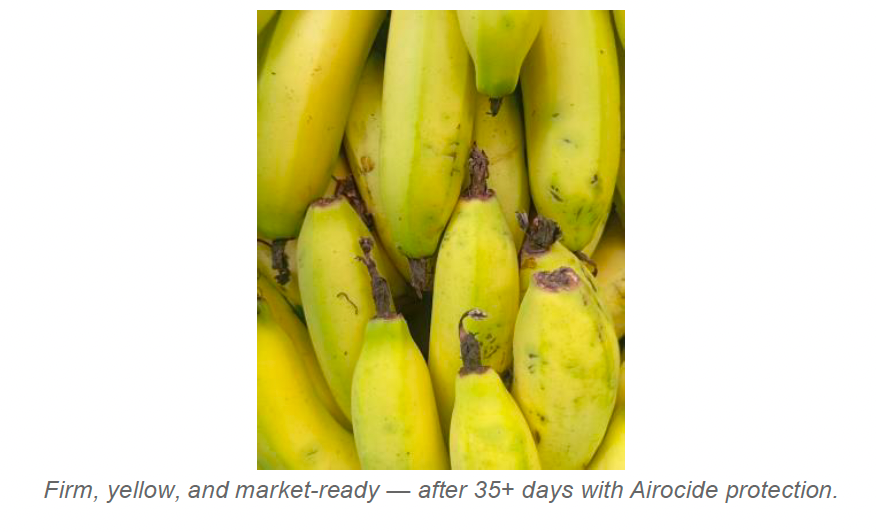
| Shelf Life | Discarded at 16 days | Viable for 35+ days | +19 days (118%) |
| Ethylene Atmosphere | Rapid, uncontrolled buildup | Continuously eliminated | Cleaner, safer storage |
| Fruit Condition | Overripe, blackened | Firm, yellow, market-ready | Premium quality retained |
The 118% shelf-life extension is consistent with published ethylene management research: potassium permanganate (KMnO₄) scavengers extend banana storage up to 45 days at 13°C [8], and 1-MCP treatments delay ripening by days to weeks [9]. Airocide achieves comparable or superior results continuously and without chemicals.
Financial Impact & ROI Analysis
By eliminating the primary catalyst for spoilage, Airocide directly converts extended shelf life into measurable financial gains. The following model is based on a conservative scenario for a distributor or ripening facility handling bananas at commercial scale:
Annual Benefits Model (Mid-Size Facility)
For a mid-size banana ripening facility (~2,000 tons/year), Airocide delivers an estimated $100,000–$150,000 in annual savings through two primary pathways:
Spoilage Reduction & Product Recovery. US commercial ripening facilities typically lose 10–15% of volume to postharvest spoilage (USDA). A 2,000-ton facility at 12% baseline loss risks ~240 tons annually. The DOD study demonstrated 118% shelf-life extension under controlled conditions; applying a conservative 35% loss reduction for commercial-scale operations recovers ~84 tons. At $0.50/lb wholesale: 84 tons × 2,000 lbs × $0.50 = $84,000 in recovered product.
Extended Marketable Window. The difference between 16 and 35+ days of viable shelf life transforms distribution economics. Longer windows reduce emergency discounting, improve fill rates, and enable holding inventory for optimal market timing. For a 2,000-ton operation, even modest reductions in forced markdowns add $20,000–$40,000 annually.
Reduced Labor and Disposal Costs. Less spoilage means less culling, re-sorting, re-packing, and disposal. For ripening operations handling millions of pounds annually, labor savings from processing fewer tons of waste add $10,000–$20,000 in operational efficiency.
| Benefit Category | Annual Value |
|---|---|
| Reduced Spoilage Losses (Shrinkage) | $84,000–$100,000+ |
| Extended Shelf Life & Quality Retention | $20,000–$40,000 |
| Reduced Labor & Handling | $10,000–$20,000 |
| Implied Annual Benefit | $100,000–$150,000+ |
Investment Analysis: The Airocide system delivers a rapid and substantial return on investment, often paying for itself within a single shipping cycle. Typical payback period: < 30 days. 5-year net ROI: $7.5M+
Methodology: Savings based on 2,000-ton facility × 12% baseline loss (USDA US commercial range) × 35% loss reduction (conservative scaling from DOD-measured 118% shelf-life extension) = 84 tons recovered × $0.50/lb wholesale. DOD study data (DTIC ADA504474). Actual results vary by facility size, variety, storage conditions, and humidity control.
Technology Comparison
Commercial & Cold Storage Context:
| Feature | Airocide PCO | KMnO₄ Scrubbers | 1-MCP Treatment |
|---|---|---|---|
| Ethylene Removal | Continuous (24/7) | Depletes over time | Blocks receptors only |
| Destroys Pathogens | Yes (96–99.9%) | No | No |
| Chemical-Free | Yes | No (toxic compound) | Chemical application |
| DOD Validated | Yes (NSRDEC) | No | No |
| Worker Safety | Safe (no emissions) | Irritant handling | Safe |
HVAC & Facility Context:
| Feature | Airocide PCO | HEPA Filters | Ozone Generators |
|---|---|---|---|
| Destroys Organics | Yes | No (Traps only) | Yes |
| Removes Ethylene Gas | Yes | No | Yes |
| Maintenance | Low (Annual) | High (Frequent changes) | Medium |
| Safety | Safe (No Emissions) | Safe | Hazardous (Lung irritant) |
| Verdict | Superior | Ineffective for Gas | Safety Risk |
Conclusion
By employing Fighter Flex UVC technology, the hotel saw not only a 24.5% increase in energy efficiency, but also significant reductions in humidity and cooling coil fouling. This technology, when implemented following ASHRAE guidelines, delivers rapid returns on investment, marking it as a disruptive and highly effective solution in energy management.
For banana storage and post-harvest preservation, Airocide represents a fundamental shift in how the industry manages freshness, spoilage, and logistics. The DOD-validated results—118% shelf-life extension, chemical-free operation, and rapid ROI—make it the clear choice for distributors, importers, ripening facilities, and military supply chains seeking to maximize product quality while minimizing operational losses.